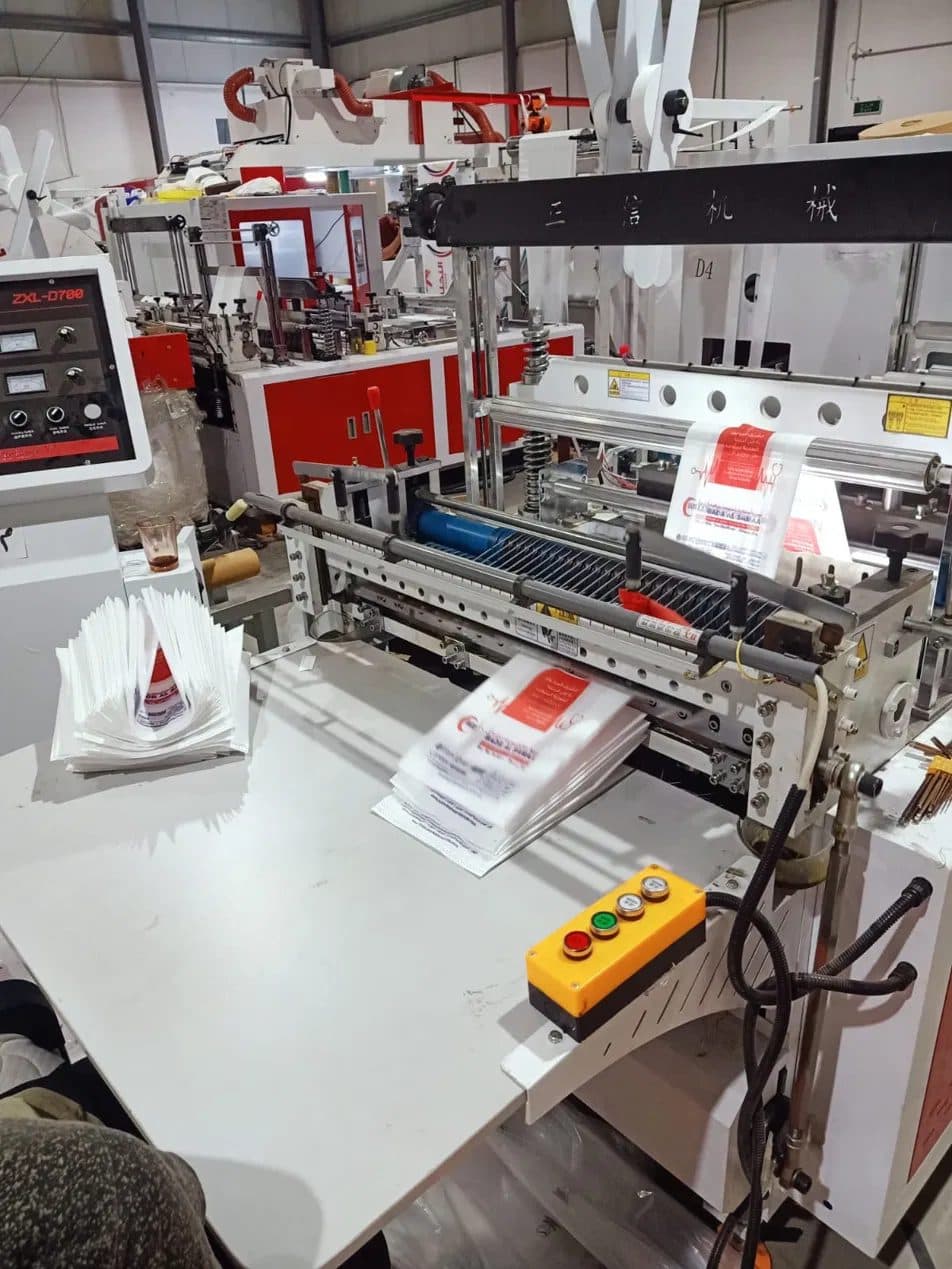
Nonwoven bags have become a standard choice for supermarkets, pharmacies, restaurants and clothing shops: they are stronger than plastic bags and carry the shop's logo clearly. A nonwoven bag factory can start with a single machine and grow step by step. This guide walks through the practical steps, based on our experience installing more than 75 machines.
1. Decide which bags you will make
The bag type decides the machine. The most common types in Egypt:
- T-shirt bags: for supermarkets and high-volume shops.
- D-cut bags: for pharmacies, phone, gift and clothing shops.
- Box bags: with a wide base, for restaurants, sweets and gifts.
- Flat bags with loop handles: for exhibitions, promotion and larger stores.
If you will serve several kinds of customers, choose a machine that makes several shapes, such as our 3-in-1, 4-in-1 or 5-in-1 machines.
2. Choose the right machine
ZXL series machines produce 40–120 bags per minute depending on the model, bag type and size; the ZX-LT500 box bag machine produces 60–80 bags per minute. All are fully automatic and usually need two operators per shift.
See the detailed comparison in: How to choose the right nonwoven bag machine →
3. Prepare space and power
- Space: ZXL machines are about 8–12 m long and 2 m wide; the ZX-LT500 box bag machine needs about 11 × 6.9 m. Leave room for fabric rolls, finished bags and packing.
- Power: ZXL machines run on 220V at 12–18 kW, while the ZX-LT500 box bag machine (50 kW) and the flexo and screen printing machines need 380V.
- Compressed air: the machines need an air compressor, which we can supply.
4. Raw material and printing
The main raw material is nonwoven polypropylene fabric in rolls; ZXL machines work with 30–120 g/m² depending on the model. If your customers want logos, you will need a 2 or 4 colour flexo printer with up to 1160 mm printing width.
Compare 2 and 4 colour printing machines →
5. Staff and training
Every machine comes with 5–10 days of hands-on operator training, depending on the machine, and an Arabic and English manual, so you do not need previous experience.
6. Installation, warranty and spare parts
- Delivery and installation anywhere in Egypt.
- Full setup and calibration, running in front of you.
- A spare parts and mold set with the machine.
- 1-year parts warranty and after-sales technical support.
7. Financing and payment
Payment is in Egyptian pounds, and the price includes supply, installation and training.
Because we are an agent, not a trader, we also offer direct import from the factory in China, so you can benefit from the tax exemptions the Egyptian government gives the industrial sector, which can reach about 20%. Prices depend on the model and options.
Start with a free consultation
Visit our office in 6th of October City for a free consultation with one of our experts, Sunday to Thursday, 9 am to 4 pm.
Message us on WhatsApp to book a consultation or get a quotation
Chat on WhatsApp